An original industry article featuring Streamling AI, without external article references or a Further Reading section.
AI Video Generation and the Future of Filmmaking, Animation, and Creative Production
Artificial intelligence is transforming the creative industry. From cinematic filmmaking and animated storytelling to advertising, digital avatars, and e-commerce content, AI is changing how visual ideas become finished productions. The next generation of creative technology is not simply about generating images or short video clips—it is about reimagining the entire creative workflow.
For decades, producing professional visual content required specialized equipment, experienced teams, significant budgets, and time-consuming production processes.
A cinematic scene might involve location scouting, camera crews, lighting specialists, actors, visual effects artists, and editors. An animated film could require months of character development, storyboarding, animation, rendering, and post-production.
These processes remain essential to many professional productions, but artificial intelligence is introducing new possibilities.
Today, creators can describe visual concepts in natural language, generate reference images, explore cinematic scenes, animate characters, create digital presenters, and experiment with visual effects that once required extensive technical resources.
The implications extend far beyond social media content.
AI-generated video is becoming part of a broader transformation affecting cinema, animation, advertising, marketing, education, and digital commerce.
At DIGEX, we believe this evolution represents an important shift in how creative technology will be designed and used.
It is also one of the reasons we are building Streamling AI, a unified creative platform designed to bring image generation, video production, cinematic workflows, animation, editing, avatars, and specialized creative tools into a connected environment.
The future of visual production is becoming more accessible, experimental, and intelligent.
But understanding that future requires looking beyond the technology itself.
1. Why AI Video Generation Is Becoming One of the Most Important Creative Technologies
The growing interest in AI-generated video is not happening in isolation.
It is being driven by a fundamental change in how businesses and audiences consume visual content.
Video has become a central format for digital communication.
Brands need product demonstrations, social media advertisements, educational videos, promotional campaigns, and content for multiple digital channels.
Online businesses increasingly rely on visual storytelling to communicate product value. Creators compete for attention in an environment where fresh content is constantly expected.
Meanwhile, traditional video production can be expensive, slow, and difficult to scale.
AI introduces an opportunity to address some of these challenges.
Growing demand for visual content
Modern companies rarely need just one promotional video.
A single marketing campaign may require multiple versions for different audiences, languages, formats, and advertising platforms.
A product launch might involve a cinematic brand video, short social media clips, product images, promotional animations, and localized advertisements.
Producing every variation through a separate traditional workflow can require substantial time and resources.
AI-assisted creative tools help teams explore and produce these variations more efficiently.
This does not remove the need for creative direction.
Instead, it allows creative professionals to spend more time developing concepts and refining ideas rather than repeatedly rebuilding similar assets.
Faster experimentation and production
Traditional visual production often requires important decisions to be made before the final result can be seen.
AI changes the economics of experimentation.
A filmmaker can test several lighting styles before committing to a shot.
An animator can explore character designs and movement concepts.
A marketing team can compare different visual treatments for the same advertisement.
Ideas that might previously have required extensive preparation can now be explored through generated images, motion studies, and short video sequences.
The advantage is not only speed.
It is the ability to evaluate more creative possibilities before committing resources.
Lower barriers to creative expression
Professional filmmaking and animation have historically required specialized technical knowledge.
AI tools are making some aspects of visual production accessible to a broader range of people.
Independent filmmakers, educators, entrepreneurs, content creators, and smaller businesses can experiment with visual ideas that may previously have been beyond their budgets.
However, accessibility should not be confused with automatic professional quality.
Creating a compelling story still requires judgment, originality, pacing, composition, and an understanding of the audience.
AI can make production tools more accessible.
It cannot guarantee that the resulting content will be meaningful.
2. From Text-to-Video to Intelligent Creative Production
The earliest popular AI video tools focused primarily on generating short clips from text prompts.
A user would describe a scene, select a model, and receive a video.
This demonstrated a remarkable technological capability, but it also exposed an important limitation.
Generating an impressive clip is not the same as producing a complete film, advertisement, or animated story.
Professional visual production requires continuity, creative direction, editing, asset management, and coordination between multiple stages.
A character should remain recognizable across scenes.
A camera movement should support the intended narrative.
Lighting and visual style should remain coherent.
Individual shots need to connect into a meaningful sequence.
Sound, dialogue, music, and pacing must work together.
This is why the creative AI industry is moving toward more integrated workflows.
The transformation is from:
Prompt → Generated Video
to:
Concept → Script → Visual References → Scene Planning → Generation → Editing → Audio → Final Production
This represents an important evolution.
AI is becoming a component of the creative production process rather than simply a generator of isolated media files.
Why workflow matters more than a single AI model
Different creative tasks require different capabilities.
One model may produce strong cinematic imagery. Another may be better suited to animation, character motion, avatars, or specific visual styles.
A practical creative platform should help users organize these capabilities into a coherent production workflow.
It should also provide ways to manage references, revise content, arrange shots, and maintain control over the final result.
At DIGEX, we believe the long-term value of creative AI will come not only from increasingly powerful models, but also from the platforms that make those models useful in real production environments.
3. How AI Is Changing the Film and Cinema Industry
Cinema is one of the most complex forms of visual storytelling.
A film combines writing, directing, acting, cinematography, production design, sound, editing, and visual effects into a single creative experience.
AI is beginning to influence several of these disciplines.
But the most interesting opportunity is not necessarily generating an entire film automatically.
It is giving filmmakers new ways to visualize, experiment, and execute their creative ideas.
Pre-production: Visualizing ideas before filming
Before a camera starts recording, filmmakers must make countless creative decisions.
How should the scene look?
What lighting creates the desired emotion?
Which camera angle best communicates the moment?
How should the environment, characters, and movement interact?
Traditionally, filmmakers use scripts, storyboards, concept art, location references, and previsualization to answer these questions.
AI-generated images and videos can accelerate parts of this process.
A director might describe a nighttime science-fiction scene with atmospheric lighting, a wide cinematic lens, and slow camera movement.
AI tools can help produce visual references for discussion, comparison, and refinement.
A production team can explore multiple approaches before investing in sets, equipment, or final visual effects.
The result is a more flexible creative planning process.
Cinematography: Exploring shots, lighting, and camera movement
Cinematography is not simply the technical act of capturing images.
It is the visual language through which filmmakers communicate emotion and meaning.
Camera position, lens selection, lighting, composition, and movement all affect how an audience experiences a story.
Advanced AI video workflows are increasingly introducing controls around these cinematic concepts.
Instead of requesting only "a beautiful cinematic scene," creators can develop more specific visual instructions.
For example:
A wide establishing shot of a futuristic city at sunset, with warm atmospheric lighting, reflections on glass buildings, and a slow forward camera movement.
The AI system can interpret this description and generate a visual approximation.
The filmmaker can then evaluate the result and refine the direction.
AI-generated footage does not always follow camera instructions precisely, and maintaining visual consistency remains challenging.
Nevertheless, these tools are creating new ways for directors and cinematographers to test visual concepts.
Visual effects and post-production
Visual effects have always expanded the possibilities of cinema.
They allow filmmakers to create environments, creatures, events, and visual transformations that would be difficult or impossible to capture physically.
AI can assist with selected parts of this process, including concept development, background generation, image manipulation, and visual experimentation.
AI-assisted editing can also help teams organize and refine certain production tasks.
The potential benefit is especially meaningful for independent filmmakers and smaller studios that may not have access to extensive visual effects resources.
However, complex productions still require professional compositing, visual consistency, accurate physical interactions, and detailed quality control.
AI is becoming another tool within the filmmaker's production toolkit.
It is not a universal replacement for traditional filmmaking techniques.
4. The Transformation of Animation and Cartoon Production
Animation is another industry where generative AI creates significant opportunities.
Traditional 2D and 3D animation involves multiple specialized stages.
Characters must be designed, environments developed, movements planned, scenes animated, and frames rendered.
Maintaining consistency across a production requires careful coordination between artists, animators, and technical teams.
AI can assist with several parts of this process.
Character and environment development
Creating an animated world often begins with visual exploration.
Artists develop characters, costumes, expressions, locations, color palettes, and environmental details.
AI image generation can accelerate early concept development by helping artists explore alternative designs and compositions.
A creator developing a fantasy cartoon might experiment with different character appearances, environments, and illustration styles before selecting a direction.
The challenge is ensuring that selected concepts remain consistent throughout the production.
A character should not unexpectedly change appearance between scenes.
A building or environment should preserve important visual details.
Reference images, character definitions, and structured production workflows can help address these challenges.
From static illustrations to animated scenes
AI-assisted animation creates opportunities to introduce movement into existing visual concepts.
An illustration can become a starting point for a short animated scene.
Artists can experiment with motion, transitions, expressions, and camera movement without manually producing every exploratory frame.
This is particularly useful for storyboarding, animatics, concept presentations, and short-form animated content.
It can also help smaller teams explore ideas for cartoons, children's educational videos, promotional animations, and independent productions.
Will AI replace traditional animators?
AI is likely to change how many animation tasks are performed, but replacing the entire profession is a much more complex proposition.
Animation depends on more than moving images.
It requires character performance, emotional timing, believable motion, visual language, and storytelling.
Professional animators understand principles such as anticipation, timing, spacing, staging, and expressive movement.
These skills remain valuable even when AI participates in production.
The role of some creative professionals may shift toward directing, refining, supervising, and integrating AI-generated material.
At the same time, automation creates genuine concerns about employment, compensation, creative ownership, and entry-level opportunities.
The most responsible future is one in which creative technology expands opportunities while respecting the expertise and rights of the people behind the work.
AI can accelerate animation production, but memorable characters and meaningful stories still depend on creative vision.
5. AI Video Generation Is Changing Advertising and Digital Marketing
While cinema and animation attract significant attention, advertising is another area where AI-generated media has clear practical applications.
Modern marketing teams must continuously produce visual content for websites, social platforms, product launches, and digital campaigns.
They also need to test different messages and creative approaches.
AI image and video generation can help organizations develop promotional assets and experiment with campaign concepts.
AI-generated video advertisements
A brand introducing a new product may want a cinematic advertisement with dramatic lighting, animated visual elements, and multiple formats for social media.
AI-assisted tools can help generate visual concepts, explore product presentations, and develop supporting video assets.
Editors and marketers can then refine the selected material into a finished campaign.
This can be especially useful for businesses that need creative variety but cannot organize a separate physical production for every experiment.
Faster creative testing
Marketing performance often depends on testing different combinations of imagery, messaging, pacing, and presentation.
AI can help generate alternative creative concepts for testing.
However, generating more advertisements does not guarantee better marketing results.
Successful campaigns still require audience understanding, strong positioning, effective storytelling, and reliable performance measurement.
The opportunity is to reduce the effort required to explore ideas—not to replace marketing strategy.
Personalized and multilingual content
Companies increasingly communicate with international audiences.
Video translation, dubbing, subtitles, and multilingual voice generation can help businesses adapt content for different markets.
AI-assisted localization creates opportunities to extend the useful life of an existing production.
Instead of recreating an entire video for every region, businesses may be able to adapt approved content using translation and voice technologies.
Accuracy, cultural context, and appropriate consent remain important, particularly when reproducing a person's voice or likeness.
6. E-Commerce, Fashion, and Product Visualization
AI-generated media is also creating new opportunities for online commerce.
E-commerce businesses depend heavily on high-quality product photography, advertising images, video demonstrations, and visual consistency.
Producing these assets across large catalogs can be expensive and operationally complex.
AI-assisted creative tools can help explore product backgrounds, marketing compositions, lifestyle concepts, and promotional videos.
Product imagery and video
Imagine an online store preparing a campaign for a new product.
The team might need a clean product image, a lifestyle presentation, a short promotional video, and several campaign variations.
A connected image and video production workflow can help create and refine these materials more efficiently.
However, product accuracy is essential.
Generated media should not misrepresent product dimensions, features, colors, materials, or performance.
For commercial applications, creative flexibility must be balanced with truthful product representation.
Fashion and brand visualization
Fashion brands regularly develop campaigns involving models, locations, lighting, styling, and seasonal concepts.
AI image and video generation can assist with moodboards, campaign visualization, creative experiments, and selected promotional materials.
Brands can explore different artistic directions without organizing a complete physical production for every concept.
Still, the use of virtual people, realistic likenesses, and synthetic models introduces questions about consent, transparency, representation, and rights.
Responsible platforms and businesses must account for these considerations.
The larger opportunity is to make visual experimentation more efficient while preserving brand identity and commercial trust.
7. Digital Avatars and AI Video Translation: New Ways to Communicate
Not every professional video requires a cinematic production.
Many businesses need educational content, onboarding materials, training presentations, product explanations, and multilingual communications.
Digital avatars and AI voice technologies provide another approach to creating these formats.
An avatar can serve as a digital presenter, delivering scripted information through generated video.
Potential applications include product demonstrations, training content, instructional videos, and internal communication.
For organizations that frequently update informational content, these formats may reduce the need to re-record every presentation.
AI-assisted translation can also help adapt video content into additional languages.
The combination of avatars, speech generation, and translation has the potential to make information more accessible across international audiences.
However, realistic digital presenters introduce important responsibilities.
Businesses should have appropriate authorization to use a person's appearance or voice, disclose synthetic representations where appropriate, and review translated content for accuracy.
The goal should be clearer communication—not creating confusion about whether a real person participated in a production.
8. Introducing Streamling AI: A Connected Creative Production Platform
At DIGEX, we are exploring these opportunities through Streamling AI.
Streamling is an AI-powered creative studio designed to bring different types of visual and multimedia production into a unified environment.
Rather than focusing exclusively on isolated image or video generation, Streamling brings together creative workspaces for generating, organizing, and editing media across different production needs.
The platform reflects our belief that creators increasingly need connected workflows—not an expanding collection of disconnected tools.
Cinematic Studio: From a creative idea to a sequence of shots
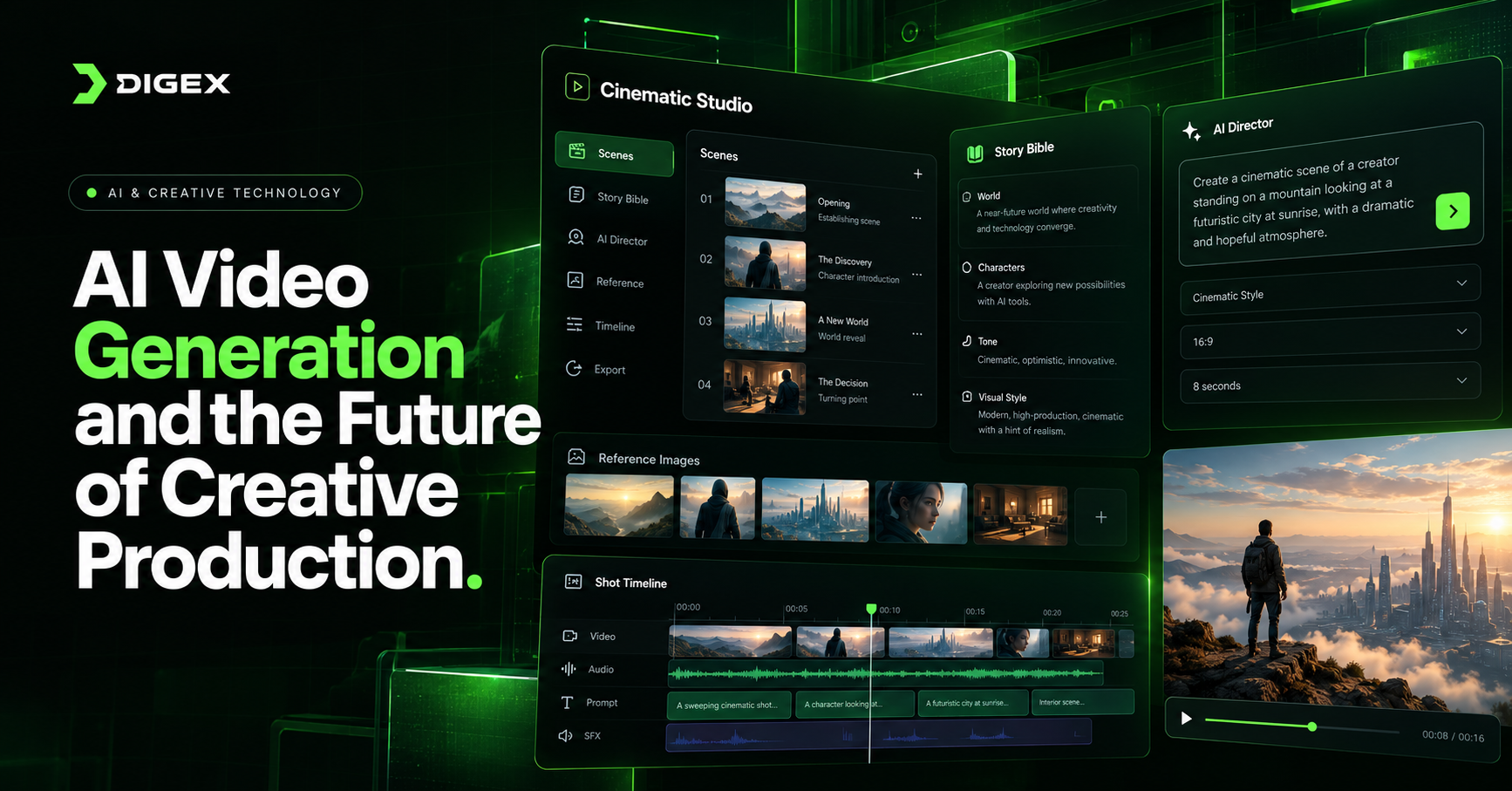
One of the central experiences in Streamling is its Cinematic Studio.
Cinematic production involves much more than entering a prompt and generating a clip.
A creator may need to define a story, establish the visual atmosphere, maintain character consistency, prepare reference images, and organize multiple shots into a sequence.
Streamling's cinematic workflow brings these concepts together through features such as an AI Director, Story Bible, scene descriptions, image references, a shot list, and a timeline-oriented workspace.
The objective is to support a more structured approach to AI-assisted cinematic creation.
Instead of treating every generation as an unrelated result, creators can work toward a connected visual sequence.
This is especially relevant for short films, cinematic concepts, story visualization, promotional sequences, and creative experimentation.
Image generation and editing
Still images remain essential to creative production.
They can serve as standalone marketing assets, visual references, character concepts, storyboards, thumbnails, and the starting point for video generation.
Streamling includes image creation and editing workflows so users can develop and refine visual material as part of a broader production process.
The aim is to make image creation a natural part of multimedia storytelling rather than a separate activity.
Video generation and editing
A generated video clip is often only an intermediate asset.
Creators may need to organize multiple clips, refine the sequence, adjust the presentation, and prepare content for delivery.
Streamling combines AI video generation with video editing workflows, supporting a transition from individual media generations toward completed creative projects.
The distinction matters because the most useful creative tools are not necessarily those that produce the most impressive single output.
They are the tools that help users turn generated material into something they can actually publish.
Animation and character-driven content
Streamling's Animation Studio provides a dedicated workspace for animation-oriented creation.
This direction reflects the growing interest in AI-assisted animated storytelling, motion concepts, and stylized video production.
Animation has different creative needs from photorealistic cinematography.
Dedicated workflows help organize those needs around the intended output instead of treating every visual project in the same way.
Avatars, audio, and video translation
Streamling also includes workspaces for digital avatars, audio production, and video translation.
Together, these capabilities support a broader range of communication and content creation scenarios.
A business may need a digital presenter, an audio component for a promotional video, or a translated version of existing content.
Keeping these capabilities within a connected creative environment can reduce fragmentation between different parts of production.
Specialized creative workflows
Beyond general-purpose image and video creation, Streamling includes industry-oriented areas such as e-commerce, brand and fashion, video advertising, and other business applications.
These categories reflect an important direction for AI creative software.
Different industries have different creative requirements.
A product advertisement, a fashion campaign, an animated cartoon, and a cinematic short film should not necessarily follow the same workflow.
Specialized tools can help bridge the gap between general AI generation capabilities and practical business needs.
9. Why Unified AI Creative Platforms Matter
The rapid development of generative AI models is creating an increasingly complex technology landscape.
Different models offer different strengths, output characteristics, controls, processing times, and costs.
Creators often face a fragmented process.
They generate an image in one application, create video in another, prepare a voiceover elsewhere, and then move the assets into an editing environment.
This introduces unnecessary complexity.
Files must be transferred, projects reconstructed, and creative context repeatedly re-established.
A unified creative platform offers a more organized approach.
One environment for different creative stages
A connected workspace can bring project assets, generation tools, editing capabilities, and production history closer together.
Creators can focus on the project instead of spending excessive time coordinating software.
Flexible access to AI capabilities
The AI model landscape is evolving quickly.
A platform designed around multiple providers can adapt as technologies improve and different production requirements emerge.
Streamling's multi-provider approach is intended to support that flexibility while keeping the creative workflow consistent.
From experimentation to repeatable production
Generating a visually impressive clip once is relatively different from managing ongoing production.
Creators and businesses need ways to organize projects, reuse approved assets, manage revisions, and prepare content for publication.
These workflow capabilities become more important as AI-generated content moves from experimentation into routine professional use.
The next competitive advantage in creative AI may come as much from production workflow and creative control as from the underlying generation models themselves.
10. The Challenges AI Creative Technology Still Needs to Solve
Although AI-generated images and videos have advanced significantly, several important challenges remain.
Acknowledging these limitations is essential to understanding the technology realistically.
Character and scene consistency
Maintaining the same character, clothing, environment, and visual style across multiple generated shots remains difficult.
Reference images and structured scene planning can improve consistency, but they do not guarantee perfect continuity.
Motion and physical accuracy
Generated movement may contain unnatural interactions, inconsistent objects, or errors in complex scenes.
Professional productions require careful review, especially when motion, precise positioning, or realistic physical behavior matters.
Creative control
A text prompt communicates an intention, but the generated output may not perfectly reflect that intention.
Professional workflows need ways to refine compositions, timing, camera movement, and visual details.
Editing and integration
AI-generated clips still need to fit into coherent productions.
Transitions, sound, pacing, color, and narrative continuity require attention.
This makes editing and human supervision essential parts of the production process.
Copyright, consent, and responsible use
Creative AI raises important questions about intellectual property, training data, commercial usage, and digital likenesses.
Businesses must consider rights to source materials, model-specific terms, permission to use recognizable people or voices, and the risk of misleading synthetic media.
These issues are particularly important in filmmaking, advertising, and commercial content.
At DIGEX, we believe responsible creative technology should support human control, transparent production practices, and respect for intellectual property.
The development of powerful AI tools must be accompanied by thoughtful decisions about how those tools are used.
11. Will AI Replace Film Studios, Animators, and Creative Professionals?
One of the most frequently discussed questions surrounding generative AI is whether it will replace traditional creative professionals.
The reality is more complex than a simple yes or no.
Some production activities are becoming easier to automate or accelerate.
Certain tasks may require fewer manual steps, and the economics of some forms of content creation may change significantly.
This could affect creative roles, business models, and employment opportunities.
At the same time, producing technically convincing images is not the same as creating meaningful visual storytelling.
A memorable film requires narrative structure, emotion, character development, pacing, and artistic direction.
A successful animation depends on expressive performance and a consistent visual world.
An effective advertisement requires a compelling message and an understanding of the audience.
These are not merely technical problems.
They are creative and human ones.
The role of the professional may evolve from manually executing every step toward directing, evaluating, refining, and integrating more of the production process.
AI may also allow independent creators and smaller studios to explore projects that previously required significantly greater resources.
We believe the most promising future is one in which AI expands creative possibilities while preserving the importance of human imagination, professional skill, and artistic ownership.
AI can generate visual possibilities. People give those possibilities meaning.
12. The DIGEX Perspective: Building the Next Generation of Creative Technology
For DIGEX, Streamling AI represents more than an individual software product.
It reflects our broader interest in building AI-native applications that solve practical problems through intelligent workflows.
Developing creative technology requires more than connecting an interface to an AI model.
It involves designing systems that coordinate different generation processes, manage asynchronous operations, store media reliably, organize projects, and provide consistent user experiences.
There are also important architectural considerations around generation costs, model selection, background processing, and the handling of large media assets.
As AI models continue to evolve, creative applications need flexible architectures that can support new capabilities without constantly rebuilding the surrounding product.
This is one reason Streamling emphasizes connected production workspaces and a multi-provider approach.
Our objective is to bring creative capabilities into a more practical environment for people who want to produce images, videos, cinematic scenes, animated content, and business media.
Technology should remove barriers—not creative control
We believe successful creative AI platforms should make sophisticated technology easier to use while giving creators meaningful control over the outcome.
A filmmaker should be able to focus on storytelling.
An animator should be able to focus on characters and motion.
A marketing team should be able to focus on communication and campaign effectiveness.
A business owner should be able to develop visual ideas without needing to coordinate an unnecessarily complex collection of technical tools.
The technology should support these goals rather than become an obstacle.
This is the direction behind Streamling AI.
Bringing generation, editing, creative planning, and production workflows closer together so ideas can become visual experiences more efficiently.
13. The Future of Visual Production Will Be Intelligent, Connected, and Human-Directed
The next stage of AI-generated media will not be defined only by improvements in image quality.
Visual fidelity will continue to matter, but professional adoption depends on additional capabilities.
Creators need consistent characters, controllable camera movement, reliable motion, editable output, coordinated audio, and tools that preserve creative context across scenes.
Businesses need repeatable workflows, dependable asset management, clear usage rights, and predictable production processes.
Film and animation professionals need technology that complements established creative disciplines.
These needs point toward a future in which AI is integrated throughout production—from early concept development to final editing.
The distinction between generating media and producing a finished creative work will remain important.
A generation model creates possibilities.
A production platform helps organize them.
And the creator determines what those possibilities become.
As technology evolves, we expect creative workflows to become increasingly connected, with AI helping people move more efficiently between ideas, visual development, generation, refinement, and publication.
But the central creative responsibility will remain with people.
Conclusion: A New Era of Creative Possibility
Artificial intelligence is opening a new chapter in visual storytelling.
It is changing how filmmakers experiment with scenes, how animators develop characters, how brands produce advertisements, and how businesses communicate visually.
It is making advanced creative capabilities more accessible while introducing new questions about quality, rights, and professional responsibility.
For the creative industry, the opportunity is not simply to produce more content.
It is to explore ideas that were previously difficult to visualize, reduce unnecessary production barriers, and give creative professionals more ways to express their vision.
At DIGEX, we see this transformation as an opportunity to build software that connects powerful AI capabilities with practical production workflows.
Through Streamling AI, we are bringing together image creation, cinematic video, animation, editing, avatars, translation, and industry-focused creative tools within a unified platform.
Our vision is a future where sophisticated creative technology is more accessible, flexible, and useful to individuals and businesses alike.
Streamling AI — From Imagination to Creation
The future of filmmaking and digital content will not belong exclusively to traditional production methods or artificial intelligence.
It will emerge from the combination of human creativity, evolving technology, and new ways of working.
Because AI is not the end of creative storytelling. It is the beginning of new possibilities for how stories can be imagined, developed, and brought to life.
Explore Streamling AI: https://www.streamling.ai/