Artificial intelligence is transforming software engineering. But the biggest opportunity isn't simply writing code faster. It's redesigning how software companies operate—combining experienced engineers, intelligent automation, stronger quality controls, and more efficient delivery models to create greater value.
Software Development in the AI Era: How to Build Faster, Deliver Better, and Create More Value
Artificial intelligence is transforming software engineering. But the biggest opportunity isn't simply writing code faster. It's redesigning how software companies operate—combining experienced engineers, intelligent automation, stronger quality controls, and more efficient delivery models to create greater value for clients.
Introduction: Software Development Is Entering a New Era
For decades, software development has followed a relatively predictable economic model.
A company identifies a business problem, defines requirements, assembles a development team, and invests engineering hours into designing, building, testing, and maintaining a solution.
More complex products typically require more developers, longer timelines, and larger budgets.
Artificial intelligence is beginning to challenge parts of this model.
Modern AI coding assistants and software engineering agents can generate implementations, analyze existing code, create tests, investigate errors, prepare documentation, and help coordinate development tasks.
Activities that previously required hours of repetitive work can sometimes be completed much more quickly.
But there is an important distinction between generating software and delivering a successful software product.
A business doesn't benefit simply because more code was written.
It benefits when the right solution is delivered reliably, solves a meaningful problem, and continues to provide value over time.
This is why the AI transformation of software engineering must go beyond coding tools.
The next generation of software development companies will need to rethink their processes, team structures, engineering practices, and commercial models.
At DIGEX, we believe the future of software development is built around a new principle:
Human expertise defines the solution. AI accelerates execution. Engineering discipline ensures quality. Business outcomes determine success.
1. AI Is Changing the Economics of Software Development
Traditional software development costs are closely connected to the amount of human effort required.
Requirements analysis, UI development, backend implementation, database design, integrations, testing, and deployment all consume engineering time.
AI can reduce the manual effort involved in selected parts of this process.
A developer can use AI to prepare repetitive API structures, generate initial test cases, explore implementation options, and understand unfamiliar sections of a codebase.
An experienced engineer may be able to investigate several technical approaches in the time previously required to implement a single prototype.
A development team can also use intelligent tools to identify inconsistencies, explain errors, and prepare documentation.
These capabilities create opportunities for faster execution.
However, the economic impact is not automatic.
AI-generated code still requires validation. Incorrect suggestions can increase debugging effort. Poorly designed automation can introduce technical debt, security vulnerabilities, and maintenance costs.
Research into AI-assisted development shows that productivity gains vary significantly depending on the task, developer experience, codebase, and surrounding engineering process.
This leads to an important conclusion:
The cost advantage of AI comes from improving the complete delivery process—not merely reducing the time spent typing code.
From development hours to total cost of ownership
A client's real software investment includes more than the initial implementation budget.
It also includes testing, deployment, operational infrastructure, maintenance, future changes, and the cost of correcting defects.
A solution delivered quickly but requiring constant fixes may ultimately be more expensive than one built with stronger architecture and validation from the beginning.
A more useful way to evaluate software economics is:
Total Software Cost = Development + Verification + Infrastructure + Maintenance + Rework + Operational Risk
AI can influence several of these components.
It may reduce implementation effort, accelerate analysis, and improve test preparation.
But if organizations neglect architecture or verification, the savings can disappear through rework and future maintenance.
The objective should therefore be to reduce the total cost of delivering and owning reliable software.
For clients, this is much more valuable than simply receiving a lower initial development estimate.
2. The Shift from Code-Centric to Outcome-Driven Engineering
One of the most important changes in software development is how engineering productivity should be measured.
Traditionally, teams have tracked hours worked, tasks completed, story points, and sometimes lines of code produced.
These measurements can provide operational information, but they do not necessarily reflect business value.
A developer may complete many tasks without improving the customer's experience.
A team may deliver a large number of features that users never adopt.
An application can be technically complete while failing to solve the original business problem.
AI makes this distinction even more important.
If generating code becomes faster, the ability to decide what should be built becomes a greater competitive advantage.
Start with the business problem, not the feature list
Imagine a logistics company requesting a new dashboard with dozens of reports.
A traditional development approach might begin by estimating the implementation of every requested screen.
An outcome-driven approach would first examine why those reports are needed.
Perhaps the real objective is to identify delayed shipments, detect inventory shortages, or improve operational decisions.
Instead of building dozens of disconnected reports, the engineering team might recommend a smaller operational dashboard with real-time alerts and actionable information.
The result could be less software to build, a shorter delivery timeline, and greater business value.
This is the difference between a development vendor that implements requests and an engineering partner that helps solve problems.
The new measure of productivity
Software companies should increasingly evaluate their performance through a combination of:
- Time from an approved requirement to usable software.
- Reliability and quality of the delivered solution.
- Customer adoption and satisfaction.
- Reduction in unnecessary development and maintenance effort.
- Business outcomes achieved through the product.
Engineering activity still matters.
But activity should support measurable results.
The most productive team is not necessarily the team that generates the most code. It is the team that delivers the greatest reliable value with the least unnecessary effort.
3. From Traditional Development Workflows to AI-Assisted Delivery
Introducing AI tools without changing development processes often creates limited organizational improvement.
A company may equip every developer with an AI assistant while continuing to use fragmented requirements, lengthy handoffs, inconsistent testing, and slow deployment processes.
Individual developers become faster, but the project may still move slowly.
This happens because software delivery is a connected system.
Improving one activity does not automatically improve the entire process.
For example, faster implementation can create more code review work. Faster code review can expose a slow testing process. Faster testing may reveal an unreliable deployment environment.
The next generation of engineering companies must optimize the complete workflow.
A modern AI-assisted software development lifecycle
Discovery and business analysis
The process begins with understanding business objectives, user needs, existing systems, and technical constraints.
AI can help analyze documentation, organize requirements, identify ambiguities, and prepare initial specifications.
However, client conversations, strategic decisions, and prioritization remain human responsibilities.
Architecture and solution design
Experienced engineers define the technical foundation, system boundaries, database structures, security requirements, integrations, and operational expectations.
AI can assist by comparing technical approaches, reviewing design documents, and identifying potential edge cases.
Architecture should remain intentional rather than emerging accidentally from generated code.
Implementation
Engineers can delegate well-defined activities to AI-assisted tools.
These might include repetitive components, API scaffolding, isolated functionality, test fixtures, documentation, and selected refactoring tasks.
The team must retain responsibility for how generated implementations interact with the wider system.
Testing and validation
AI can help create test scenarios, identify uncovered cases, and examine changes for potential defects.
But generated tests must themselves be reviewed.
Successful automated tests do not automatically prove that business requirements, security expectations, and architectural standards have been satisfied.
Code review and integration
Every change should be evaluated within the context of the complete application.
Reviewers should assess correctness, security, maintainability, performance, and unintended effects.
Automated review tools can assist, while engineers remain responsible for accepting sensitive or consequential changes.
Deployment and monitoring
Automated delivery pipelines can reduce the effort required to release software.
Teams should use appropriate staging environments, deployment controls, monitoring, and rollback mechanisms.
AI may assist with operational analysis, but production changes should be governed by explicit authorization.
Continuous improvement
After release, the team evaluates performance, defects, customer feedback, and actual product usage.
This information becomes the starting point for the next development cycle.
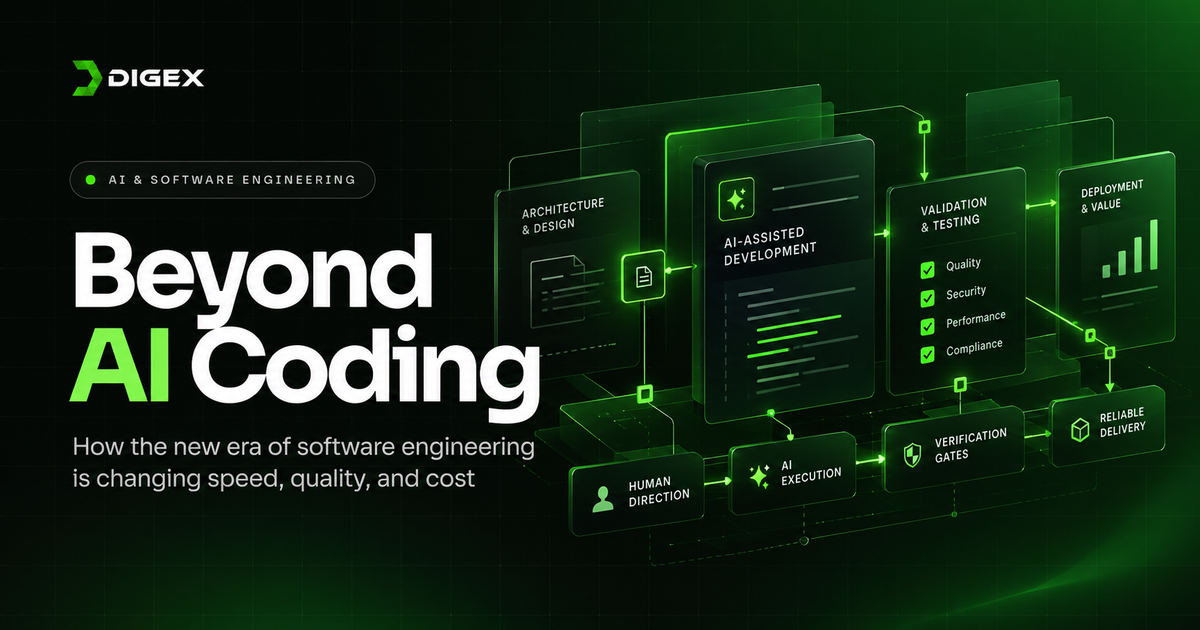
The complete process becomes:
Understand → Design → Build → Verify → Release → Measure → Improve
This continuous workflow is far more valuable than treating AI as a shortcut for writing code.
4. AI Agents Are Becoming Part of the Engineering Team
AI-assisted software development is evolving beyond simple code suggestions.
An AI coding assistant typically helps a developer with a specific request.
An AI engineering agent can work through a sequence of related activities toward a defined objective.
For example, an agent may be assigned to investigate a reported issue.
It can inspect relevant files, analyze the existing implementation, propose changes, execute permitted tests, and prepare a draft for review.
This creates opportunities to automate more complete development tasks.
However, software engineering agents should not be treated as unrestricted replacements for experienced developers.
Their effectiveness depends on context, task clarity, available tools, and the quality of verification.
Delegating work according to risk
A practical engineering organization can classify activities into different levels of responsibility.
Low-risk activities may include documentation updates, code explanations, initial test drafts, and isolated boilerplate generation.
These are often suitable for greater automation, provided basic validation remains in place.
Medium-risk activities may include implementing defined features, modifying application interfaces, updating database queries, or integrating APIs.
AI can assist significantly, but engineers should review the results and validate system behavior.
High-risk activities include authentication, authorization, payment processing, financial calculations, database migrations, infrastructure security, and changes affecting sensitive information.
These require stronger controls, explicit review, and careful testing.
The principle is simple:
The level of automation should reflect the risk and reversibility of the action.
A professional engineering company must define not only what AI agents can do, but also what they are not authorized to do.
5. How Software Development Companies Should Organize Their Teams
The introduction of intelligent tools creates an opportunity to rethink traditional development team structures.
Historically, projects have often been organized around separate functional groups.
Business analysts prepare requirements. Designers create interfaces. Backend and frontend developers implement features. QA engineers test them. DevOps specialists handle deployment.
This specialization provides valuable expertise.
However, excessive separation can introduce delays and unnecessary handoffs.
AI-native engineering encourages a more integrated approach.
Small, cross-functional teams with clear ownership
Rather than building large teams around every possible role, companies can organize compact groups around specific products or customer outcomes.
A delivery team might include a technical lead, a product or project owner, and a small group of engineers with complementary skills.
Design, security, QA, and infrastructure expertise can be embedded or shared according to project requirements.
AI tools support the team by reducing repetitive work, preparing information, and assisting with implementation and verification.
The goal is not to force every engineer to become an expert in every discipline.
It is to make collaboration easier and reduce unnecessary dependence on organizational handoffs.
The changing role of senior engineers
As AI becomes more capable at producing implementation code, senior engineering expertise becomes increasingly important.
Experienced developers are responsible for understanding business logic, making architectural decisions, evaluating tradeoffs, identifying hidden risks, and maintaining technical consistency.
They can also guide AI-assisted implementation through specifications, repository conventions, and automated validation.
A senior engineer increasingly acts as both a solution architect and a supervisor of intelligent development workflows.
This requires skills beyond prompt writing.
It requires strong software engineering fundamentals.
The changing role of project management
Project managers and product owners also gain new opportunities.
AI can assist with requirements organization, meeting summaries, dependency analysis, delivery reporting, and risk identification.
This allows project leaders to focus more on client communication, prioritization, delivery coordination, and resolving obstacles.
Rather than simply managing task completion, project leadership becomes more focused on ensuring that the project produces the intended outcome.
Quality assurance becomes continuous
Testing should no longer be treated only as a final phase after development.
In an effective AI-assisted organization, quality assurance is integrated throughout the engineering lifecycle.
Engineers write or generate tests alongside implementation.
Automated pipelines validate changes continuously.
QA specialists focus on risk-based testing, user workflows, integration behavior, and scenarios that require broader judgment.
AI can help expand coverage, but human expertise remains essential for deciding whether the application actually behaves as the customer needs.
The result is a team organized around shared delivery responsibility rather than isolated task execution.
6. Why Strong Engineering Standards Matter More in the AI Era
Artificial intelligence lowers the effort required to produce code.
But it can also lower the effort required to produce poor code.
An AI system may generate an implementation that appears correct while introducing duplicated logic, insecure assumptions, inefficient queries, or unnecessary complexity.
This is especially dangerous in mature applications with established architecture and business rules.
A local change may pass its immediate tests while violating broader system expectations.
For this reason, AI-assisted engineering requires stronger technical discipline—not weaker standards.
Architecture before automation
Projects should establish clear architectural boundaries.
Developers and AI agents need to understand where business logic belongs, how application modules interact, which services own important data, and which operations require authorization.
Consistent architecture reduces the risk of fragmented implementations.
It also improves long-term maintainability.
Clear engineering standards
Development teams should maintain documented conventions for application structure, naming, testing, security, and deployment.
These conventions should be accessible to both human engineers and authorized AI tools.
A shared engineering foundation allows intelligent systems to work more consistently within the project's expectations.
Automated verification as a foundation
Automated tests, static analysis, dependency checks, and continuous integration become increasingly important as implementation accelerates.
The faster code is produced, the more important it becomes to verify changes efficiently.
However, passing tests should not become the only measure of quality.
Security, architectural consistency, performance, usability, and maintainability require additional evaluation.
Human responsibility for production systems
AI-generated output should not bypass established approval processes simply because a tool presents it confidently.
Sensitive changes require appropriate engineering review.
Production credentials, customer data, and infrastructure permissions must be protected.
Organizations should use least-privilege access, isolated execution environments where appropriate, and clear audit records for agent actions.
These controls help engineering teams benefit from automation without introducing unnecessary operational risk.
AI can accelerate implementation. Engineering governance makes that acceleration sustainable.
7. Building an Engineering Knowledge System
A major limitation of many development organizations is fragmented technical knowledge.
Important decisions are distributed across repositories, project management tools, documentation, messages, and individual experience.
Developers may repeatedly investigate problems that another team has already solved.
Project knowledge can disappear when employees change assignments.
AI-native engineering creates an opportunity to make trusted technical context more accessible.
Knowledge as part of the development infrastructure
Useful engineering knowledge includes:
- Business requirements and acceptance criteria.
- Architecture decisions and system diagrams.
- API contracts and integration specifications.
- Security rules and deployment procedures.
- Previous defects and their resolutions.
- Test expectations and operational constraints.
When this information is maintained reliably, authorized AI systems can help developers navigate projects and make better-informed implementation decisions.
For example, before modifying a payment workflow, an engineer could retrieve relevant architectural rules, earlier integration decisions, and existing test scenarios.
AI can assist with this retrieval and synthesis.
However, generated summaries should remain grounded in authoritative project information.
Outdated documentation or incorrect assumptions can spread errors just as efficiently as accurate knowledge can improve productivity.
The objective is not to create an enormous archive of documents.
It is to establish a reliable and maintainable source of technical context.
Over time, this can become an important organizational advantage.
8. Cost-Effective Development Requires a Different Delivery Model
One of the greatest opportunities created by AI is improving the value clients receive from their software development budgets.
However, lower development costs should not come at the expense of reliability or transparency.
For clients, cost-effectiveness means achieving the desired outcome with a reasonable investment and manageable long-term operating costs.
This requires changes in how software companies estimate, prioritize, and deliver projects.
Start with a focused discovery phase
Unclear requirements are among the most expensive sources of rework.
Before committing to a large implementation, engineering teams should clarify business goals, essential workflows, integrations, technical constraints, and acceptance criteria.
AI can accelerate the preparation and analysis of these materials.
The result should be a shared understanding of the solution rather than an unnecessarily large specification that becomes obsolete before development begins.
Build the highest-value functionality first
Not every requested feature contributes equally to business value.
A strong delivery process separates essential capabilities from optional enhancements.
Instead of building an entire system before users can evaluate it, teams should aim to deliver valuable functionality in small, usable increments.
This helps clients validate assumptions earlier and avoid investing heavily in features that do not solve real problems.
Use reusable foundations intelligently
Many applications share common technical requirements such as authentication, access control, notifications, audit logs, integrations, and administrative interfaces.
Reusable components and proven architectural patterns can reduce duplicated engineering effort.
AI can assist with adaptation and implementation, but reuse must remain appropriate for the project's actual requirements.
The purpose is to avoid solving the same problem repeatedly—not to force every project into a generic template.
Choose technology based on total value
The newest technology is not always the best solution.
A conventional application with carefully designed automation may be more reliable and economical than an unnecessarily complex agentic system.
Likewise, a new AI-native architecture may be justified when it creates meaningful operational advantages.
An engineering partner should evaluate development complexity, maintenance requirements, infrastructure costs, integration needs, and future flexibility before recommending an approach.
Make cost savings measurable
If AI reduces effort in a project, the benefit should be evaluated through actual delivery metrics.
Relevant measures include time to production, rework, defect rates, engineering effort, and ongoing maintenance needs.
AI model usage and tooling also have costs, including subscriptions, API consumption, evaluation, and operational monitoring.
Professional software companies should account for these costs rather than assuming AI-generated work is free.
The real opportunity is to make the client's investment work harder—not to promise arbitrary reductions in project prices.
9. From Hour-Based Outsourcing to Value-Oriented Engineering Partnerships
The traditional outsourcing industry has often been built around selling development capacity.
Clients hire a defined number of developers for an agreed period.
The model is straightforward and remains appropriate for many engagements.
But AI-assisted software development creates an important commercial question.
If intelligent tools help an experienced team deliver the same outcome with less effort, should the value of the engagement still be measured primarily by the number of hours worked?
Increasingly, clients will be interested in delivery capability rather than staffing volume alone.
They want to know how quickly a useful product can be delivered, what risks are involved, how quality will be verified, and what the solution will cost over time.
A more flexible commercial approach
Different projects require different engagement models.
A well-defined feature or product milestone may be suitable for a fixed scope and agreed price.
A complex initiative with evolving requirements may benefit from time-and-materials collaboration with transparent budgets and regular review.
A product discovery engagement may be priced separately to reduce uncertainty before implementation.
For some projects, commercial arrangements can also incorporate agreed delivery outcomes and service expectations.
No single pricing model is universally superior.
The important principle is alignment between incentives and customer value.
Clients should not be encouraged to buy unnecessary engineering hours, and development companies should not sacrifice quality to meet unrealistic fixed budgets.
The engineering partner of the future
A modern software development partner should help clients answer more than technical implementation questions.
It should help determine:
Which capabilities create the greatest business value? What can be reused? Where can AI reduce effort? Which processes should remain deterministic? How will we validate the result? What will the system cost to operate and maintain?
These questions create a different relationship between the client and the engineering team.
The developer is no longer viewed only as an implementer of requirements.
The engineering company becomes a partner in achieving business outcomes.
10. Measuring Real Productivity: Beyond Lines of Code
AI makes traditional productivity measurements less reliable.
A developer may generate hundreds of lines of code in minutes, but those lines may introduce defects or unnecessary complexity.
A small architectural improvement might eliminate thousands of lines of future maintenance work.
Measuring productivity solely through code volume misses this distinction.
Software companies need balanced performance indicators.
Delivery performance
Measure how long meaningful changes take to reach production, how frequently software can be released safely, and where work becomes delayed.
Large changes that sit in review for weeks may indicate process problems even when implementation is fast.
Reliability and quality
Track production failures, regressions, recovery time, and unplanned rework.
An increase in delivery speed should not be accepted as a success if software stability deteriorates.
Engineering efficiency
Examine review effort, repetitive tasks, workflow bottlenecks, and the cost of maintaining existing functionality.
AI should reduce unnecessary effort across the lifecycle, not simply move it from development to debugging and review.
Business value
Measure whether the delivered functionality improves the outcomes the client cares about.
Depending on the product, that may involve user adoption, conversion rates, reduced operational effort, increased revenue, or improved customer satisfaction.
Sustainable team performance
Engineering organizations should also consider developer well-being, knowledge development, and the ability to maintain technical ownership.
A team that temporarily produces more code by sacrificing training, review, or sustainable working practices may create future problems.
These measurements should be used to improve systems and workflows—not to rank individuals based on simplistic productivity scores.
The most useful productivity metric is the sustainable delivery of valuable, reliable software.
11. How a Software Company Can Transition Toward AI-Native Engineering
Becoming an AI-native engineering organization does not require replacing the entire development process overnight.
A more practical approach is to improve the system incrementally and evaluate each change.
Phase 1: Understand the current delivery process
Start by mapping how projects move from customer requests to production.
Identify where time is spent and where work becomes delayed.
Common bottlenecks include unclear requirements, repetitive implementation, slow reviews, fragile testing, and manual deployments.
Establish baseline measurements before introducing major changes.
Without a baseline, perceived improvements can be mistaken for real productivity gains.
Phase 2: Establish shared AI and engineering standards
Define approved AI tools, data-handling rules, access permissions, code review requirements, and safe development practices.
Provide teams with clear guidance on acceptable uses of AI.
Ensure that generated output is subject to the same engineering standards as human-written code.
Phase 3: Introduce AI into selected workflows
Begin with activities that are repetitive, measurable, and relatively low risk.
Examples include test preparation, documentation, codebase exploration, and well-defined implementation tasks.
Compare results with previous methods.
Evaluate both time saved and additional verification effort.
Phase 4: Integrate AI into the development lifecycle
Once selected workflows demonstrate value, connect AI assistance with requirements, engineering repositories, testing pipelines, and project documentation.
Create reusable instructions and project-specific technical context.
Maintain clear accountability for decisions and approvals.
Phase 5: Introduce controlled engineering agents
Delegate larger but well-scoped tasks to agents operating within defined boundaries.
Require validation and review before integrating changes into production code.
Sensitive systems should have stronger authorization and testing requirements.
Phase 6: Continuously improve the operating model
Review results regularly.
Which workflows became faster?
Where did AI introduce additional rework?
Did software quality improve?
Did clients receive value earlier?
What costs were added or reduced?
Use these findings to refine the process.
The transformation should remain evidence-driven.
Becoming AI-native is not about adopting every new technology. It is about learning how to apply intelligence where it creates measurable value.
12. What This Means for Clients Choosing a Development Company
As AI coding tools become widely available, clients may find it increasingly difficult to distinguish between development providers.
Many companies will advertise faster delivery, lower costs, and AI-powered engineering.
But claims alone do not demonstrate capability.
Clients should look for evidence of a reliable delivery process.
A strong engineering partner should be able to explain how it approaches architecture, testing, security, change management, and long-term maintainability.
It should also be transparent about which activities are AI-assisted and how generated work is verified.
More importantly, it should be able to connect technical decisions to business outcomes.
A good partner does not automatically recommend the largest project or the most complicated technology.
It helps the client identify a practical path toward the desired result.
For example, a business requesting a custom SaaS platform may benefit from a phased approach that delivers essential workflows first and introduces additional capabilities as real usage data becomes available.
An existing business application may benefit more from targeted improvements and automation than from a complete rewrite.
A company exploring agentic AI may first need reliable APIs, structured data, and clear operating policies.
The value of an engineering partner lies in recognizing these distinctions.
Clients should expect more than rapid code production.
They should expect technical judgment, disciplined execution, transparent collaboration, and responsibility for the quality of the solution.
13. The DIGEX Perspective: Building Software with Greater Intelligence and Responsibility
At DIGEX, we see the evolution of artificial intelligence as an opportunity to rethink how software engineering companies create value.
Our foundation is in custom software development, SaaS platforms, web applications, integrations, and business automation.
These disciplines require more than implementation skills.
They demand an understanding of business processes, scalable architecture, data integrity, user experience, security, and long-term system reliability.
AI introduces new ways to accelerate parts of this work.
But we believe the real opportunity lies in combining intelligent tools with experienced engineering teams and better delivery practices.
Our direction is built around four priorities.
Faster delivery through intelligent workflows
We want to reduce repetitive engineering work, improve access to technical context, and use AI-assisted tools where they can meaningfully accelerate development.
The objective is to shorten the path from an understood business requirement to verified, usable software.
Quality and security by design
Faster development must not weaken the standards expected of professional software.
We believe architecture, security, testing, and maintainability should remain integral to delivery.
Intelligent automation should operate within clearly defined technical boundaries and validation processes.
Cost-effective solutions with long-term value
We believe clients benefit most when development effort is focused on the capabilities that matter.
That means selecting appropriate technology, reducing unnecessary complexity, reusing reliable foundations, and considering operational and maintenance costs from the beginning.
Lower effort is valuable when it results in a more economical and dependable solution.
Stronger engineering partnerships
We want to approach software development as a partnership focused on outcomes.
That means understanding the client's business, questioning unnecessary complexity, providing clear technical recommendations, and maintaining transparent communication throughout delivery.
AI can improve execution, but trust still depends on people taking responsibility for the work.
AI should amplify experienced engineers
One of our central beliefs is that the future of professional software development does not require choosing between human engineers and intelligent systems.
Experienced engineers provide judgment, architectural understanding, and accountability.
AI tools can support implementation, analysis, and repetitive technical activities.
Together, they create opportunities to build more effectively than either approach alone.
This is the engineering direction we believe will define the next generation of technology companies.
14. The Future of Software Development: More Value, Less Unnecessary Complexity
Artificial intelligence is changing software development, but its greatest effect may be on how engineering organizations operate rather than on code generation alone.
The next competitive advantage will not necessarily belong to the company with the largest development team or the most AI subscriptions.
It will belong to organizations that can combine technical expertise, intelligent workflows, reliable infrastructure, and continuous learning.
Companies that define requirements clearly will reduce rework.
Companies that maintain strong architecture will make automation more effective.
Companies that invest in testing and deployment will be better prepared to manage faster implementation.
Companies that organize teams around outcomes will have greater opportunities to reduce coordination costs.
And companies that measure customer value rather than code volume will be better positioned to make meaningful improvements.
This transformation also changes what clients should expect.
Software should become easier to experiment with, faster to refine, and more economical to develop in situations where AI creates genuine efficiencies.
At the same time, businesses should continue to demand security, transparency, maintainability, and professional responsibility.
The future is not simply faster coding.
It is a better way to engineer software.
Conclusion: From Writing Code to Engineering Value
The AI era is redefining software development.
AI assistants and engineering agents are expanding what development teams can accomplish.
But technology alone cannot guarantee better products, lower costs, or successful delivery.
Those outcomes require a deliberate operating model that connects business understanding, experienced engineering, intelligent execution, continuous verification, and measurable results.
The most successful software companies will not treat AI as a shortcut around engineering discipline.
They will use it to strengthen that discipline and eliminate unnecessary work.
They will build teams around responsibility rather than task volume.
They will design processes where quality is continuous rather than something checked at the end.
And they will measure their success through the value their clients receive.
DIGEX — Engineering What's Next
At DIGEX, we believe the future of software development belongs to companies that combine human expertise, AI-assisted engineering, and a relentless focus on quality and business value.
Our direction is to build faster and more intelligently, reduce unnecessary complexity, and help clients achieve better outcomes through modern software engineering.
Because the next era of development is not about producing more code.
It's about delivering more value—with greater speed, stronger quality, and smarter use of every resource.
Build what's next with DIGEX.