The next evolution of accounting isn't simply about adding artificial intelligence to existing software. It's about rethinking how financial systems understand information, execute workflows, and support better decisions—with accountability built into every step.
Accounting Is Entering a New Era
For decades, accounting software has helped businesses record transactions, organize financial information, and produce reports. Spreadsheets became digital ledgers. Manual processes evolved into automated workflows. Cloud platforms made financial data more accessible.
Yet one fundamental challenge remains: much of the work still depends on people moving information between systems, reviewing transactions, resolving inconsistencies, and making repetitive decisions.
Finance teams often spend valuable time reconciling bank accounts, matching invoices, investigating exceptions, and preparing month-end reports. Meanwhile, business leaders need timely answers about cash flow, profitability, and financial risk.
Artificial intelligence promises to change this.
But not all AI-powered accounting systems are designed the same way.
There is a meaningful difference between AI-enabled, AI-native, and agentic accounting software. Understanding these concepts is essential for businesses evaluating the next generation of financial technology.
More importantly, the future isn't simply about making accounting autonomous.
It's about making accounting intelligent, proactive, explainable, and controlled.
1. AI-Enabled Accounting: Making Traditional Software Smarter
AI-enabled accounting software introduces artificial intelligence into an existing accounting architecture.
The underlying system remains largely unchanged, but AI helps users complete specific tasks more efficiently.
For example, AI-enabled software may:
- Suggest expense categories for bank transactions.
- Extract information from invoices and receipts.
- Identify potentially duplicated transactions.
- Highlight unusual financial activity.
- Generate explanations or summaries from accounting data.
These capabilities can deliver meaningful improvements.
Instead of entering every transaction manually, an accountant might receive suggested classifications. Rather than reviewing hundreds of invoices individually, the system may identify those requiring additional attention.
However, AI-enabled software often operates primarily as an assistant.
It helps users make decisions, but the existing workflow still determines how work progresses.
The distinction: AI-enabled accounting makes traditional workflows smarter without necessarily redesigning the underlying operating model.
This is an important step forward—but it is not the complete transformation.
2. AI-Native Accounting: Intelligence Built Into the Foundation
AI-native accounting represents a more fundamental architectural shift.
Instead of introducing AI as an additional feature, an AI-native system is designed from the beginning to incorporate intelligence into how financial information is interpreted, organized, and processed.
This changes what accounting software can do.
Traditional accounting systems excel at storing structured information. They record transactions, maintain accounts, and calculate balances according to predefined accounting rules.
An AI-native platform retains those essential capabilities while introducing context-aware intelligence across financial operations.
For example, the system can be designed to understand relationships between:
- Vendors, customers, and previous transactions.
- Invoices, purchase orders, and supporting documents.
- Bank activity, payment records, and ledger entries.
- Accounting policies, approval requirements, and financial periods.
- Historical decisions, recurring patterns, and exceptions.
A transaction becomes more than an amount, date, and description.
It becomes part of a larger financial context.
From storing information to understanding financial activity
Consider a recurring invoice from a cloud infrastructure provider.
A conventional accounting system records the vendor, invoice amount, expense account, and payment status.
An AI-native system can also use historical classifications, vendor relationships, approved decisions, and company-specific accounting policies to propose an appropriate treatment.
If the transaction differs significantly from established patterns, the system can flag the exception rather than blindly applying a previous decision.
This introduces a valuable capability: financial intelligence informed by business context.
Approved human decisions can also become useful institutional knowledge, helping future recommendations become more relevant and consistent.
But AI-native architecture alone does not guarantee autonomous execution.
A platform may understand financial information intelligently while still requiring people to initiate and approve every workflow.
That leads to the next distinction.
3. Agentic Accounting: From Recommendations to Action
Agentic accounting introduces AI systems that can pursue defined financial objectives through a sequence of controlled actions.
Rather than responding only to individual user requests, an AI agent can observe a workflow, determine the next appropriate step, select permitted tools, evaluate results, and escalate exceptions when necessary.
Imagine a finance professional giving an accounting system the objective:
"Review incoming vendor invoices, verify their supporting evidence, and prepare valid bills for approval."
A conventional AI assistant might explain how to complete this task.
An agentic accounting system can be designed to participate directly in the workflow.
It may inspect an invoice, identify the vendor, retrieve a related purchase order, compare receipt evidence, check for duplicates, and prepare a proposed accounting action.
Importantly, agentic does not have to mean unrestricted autonomy.
A well-designed financial agent operates within defined permissions, approval policies, and accounting controls.
What does agentic accounting look like in practice?
Consider an illustrative accounts payable workflow.
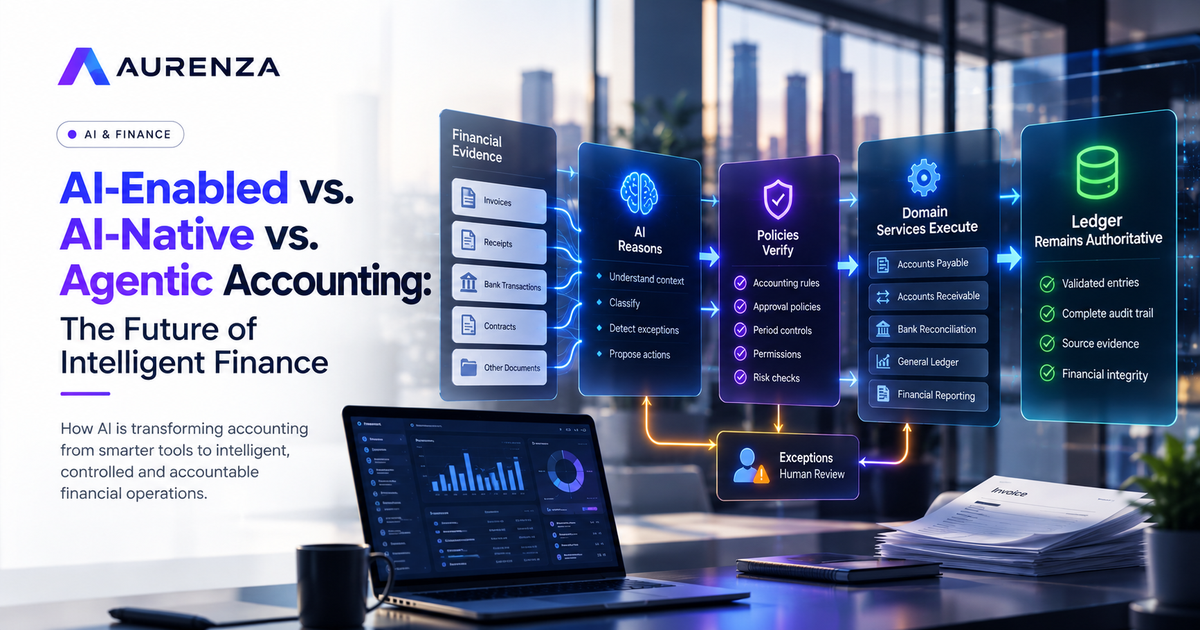
Step 1 — Observe: An AI agent detects a new supplier invoice and retrieves the supporting documentation.
Step 2 — Understand: The agent identifies the supplier, invoice details, purchase order, historical transactions, and relevant accounting context.
Step 3 — Analyze: It compares the invoice with purchasing and receipt evidence, evaluates possible duplicates, and proposes the appropriate accounting treatment.
Step 4 — Verify: The system checks the proposal against company policies, authorization requirements, accounting periods, and applicable ledger rules.
Step 5 — Act or escalate: If the action is permitted, an authorized service can advance the workflow. If information is missing, conflicting, or outside the permitted automation boundary, the issue is routed for human review.
Step 6 — Preserve evidence: The decision, supporting documentation, approval history, and accounting outcome remain traceable.
The goal is not to remove accountants from financial operations.
It is to reduce repetitive work so accounting professionals can concentrate on exceptions, financial judgment, and higher-value decisions.
4. AI-Enabled vs. AI-Native vs. Agentic: Understanding the Difference
These terms are closely related, but they are not interchangeable.
| Dimension | AI-Enabled | AI-Native | Agentic |
|---|---|---|---|
| Core idea | Enhance accounting with AI features | Design intelligence into the platform | Use agents to advance workflows |
| Primary distinction | Added functionality | System architecture | Operational behavior |
| AI responsibility | Suggest and assist | Understand context and support decisions | Plan, coordinate, and take permitted actions |
| Typical workflow | Human-led with AI assistance | Context-aware, with varying automation | Goal-driven within defined boundaries |
| Learning | Depends on implementation | Can integrate memory and feedback | Can use outcomes to improve future actions |
| Human involvement | Often reviews routine suggestions | Governs decisions and exceptions | Sets policy, authorizes sensitive actions, and handles exceptions |
The most important point is that AI-native describes how a system is built, while agentic describes how it behaves.
An AI-native platform does not automatically have agentic capabilities. Likewise, agentic workflows can be connected to traditional systems, although their effectiveness depends on the available context, integrations, and controls.
Combining an AI-native foundation with governed agentic execution creates the opportunity for a more capable financial operating model.
5. Why Financial AI Needs More Than Intelligence
Accounting is different from many other applications of artificial intelligence.
An incorrect product recommendation may be inconvenient. An incorrect financial posting can affect reporting, tax treatment, business decisions, and audit evidence.
Financial systems must satisfy requirements that go beyond generating plausible answers.
They need consistency, authorization, traceability, and dependable accounting logic.
This creates an essential distinction between AI reasoning and financial execution.
A language model may propose an accounting entry, but that does not mean it should be allowed to post directly to the general ledger.
The proposed entry must still satisfy requirements such as:
- Balanced journal entries and valid account classifications.
- Company-level access permissions.
- Approval requirements and separation of duties.
- Accounting period restrictions.
- Supporting evidence and audit history.
- Controls against unintended duplicate processing.
These requirements should not depend exclusively on the judgment of an AI model.
They should be enforced by reliable accounting services and deterministic business rules.
Intelligent reasoning helps determine what should happen. Accounting controls determine what is allowed to happen.
This separation is fundamental to trustworthy agentic finance.
Human oversight is a design principle, not a limitation
The purpose of agentic accounting is not to eliminate financial responsibility.
Businesses still need accountable professionals who establish policies, assess material risks, approve sensitive actions, and interpret financial results.
AI can perform preparation, research, classification, matching, and exception detection.
Humans remain responsible for governance, professional judgment, and decisions requiring accountability.
The strongest approach combines the speed of intelligent automation with the discipline of established financial controls.
6. Introducing Aurenza: AI-Native Accounting with Governed Agentic Intelligence
At Aurenza, we believe the next generation of accounting platforms should be intelligent by design—and accountable by default.
Aurenza is being built as an AI-native, agentic accounting platform that brings financial records, operational workflows, intelligent assistance, and accounting governance into a connected environment.
Our approach is based on a simple architectural principle:
AI reasons. Policies verify. Domain services execute. The ledger remains authoritative.
This means AI is not treated as an unrestricted system with permission to modify financial records whenever it reaches a conclusion.
Instead, intelligence operates alongside a structured financial control framework.
The platform is designed to bring together four essential capabilities.
An authoritative accounting foundation
Reliable financial operations begin with a dependable system of record.
Aurenza places ledger integrity, accounting periods, financial reporting, and controlled posting at the center of its architecture.
AI-generated recommendations must respect the same accounting rules that govern authorized human activity.
The general ledger remains the authoritative source of financial truth.
Evidence-first financial workflows
Financial decisions need supporting context.
Aurenza's approach connects accounting activity with relevant source evidence, including bank transactions, documents, approvals, and operational records.
Rather than treating an AI response as sufficient justification for a financial action, the architecture is designed to preserve the relationship between the recommendation, its supporting evidence, and the resulting accounting outcome.
This helps finance teams answer important questions:
What happened? Why was this treatment proposed? Who authorized it? Which evidence supports the result?
Context-aware intelligence and financial memory
Aurenza incorporates AI intelligence into accounting workflows through classification proposals, confidence signals, vendor memory, and exception management.
Approved outcomes can inform future recommendations, helping preserve useful knowledge from previous financial decisions.
The objective is not simply to make predictions.
It is to support more consistent decisions using relevant accounting context, historical evidence, and company-specific policies.
Governed agentic execution
Aurenza's agentic architecture is designed around explicit tools and controlled accounting services.
Agents can reason, propose actions, coordinate workflows, and escalate uncertain situations.
Permissions, accounting policies, period restrictions, and approval requirements determine whether a proposed action can proceed.
This creates a clear separation between intelligence and authority.
AI can assist with the decision. It cannot bypass the financial control boundary.
7. From Transaction Processing to Intelligent Financial Operations
The long-term opportunity of AI-native agentic accounting extends beyond automating bookkeeping.
Modern finance teams operate across multiple interconnected functions.
Accounts payable must coordinate invoices, purchasing, and payments. Banking requires reconciliation and investigation. Reporting depends on accurate journal entries. Financial close requires evidence, approvals, and period readiness.
When these activities are fragmented, information moves slowly and exceptions become harder to manage.
A connected AI-native accounting platform can provide a foundation for coordinated intelligence across those workflows.
Banking and reconciliation
AI-assisted matching can help identify relationships between bank transactions and accounting records.
Clear matches can be prepared for permitted processing, while missing payments, conflicting evidence, or unusual activity can be routed for review.
Accounts payable and receivable
Intelligent workflows can assist with document interpretation, payment matching, duplicate detection, and invoice processing.
Agentic coordination can help advance routine tasks while preserving approval requirements and supporting evidence.
Financial close
Closing an accounting period involves more than producing reports.
Finance teams must resolve outstanding transactions, complete reconciliations, verify approvals, and ensure that evidence is sufficient.
Intelligent agents can assist by evaluating readiness, highlighting unresolved exceptions, and helping teams understand what remains before closing.
Financial intelligence and CFO insights
Historical reports explain what has already happened.
AI-native financial intelligence can also help identify developing patterns, cash-flow pressures, unusual financial activity, and questions requiring management attention.
Machine learning can contribute classification, matching, anomaly, and forecasting signals, while accounting controls preserve the integrity of recorded financial information.
This is where accounting begins to evolve from a predominantly reactive process toward more proactive financial operations.
For Aurenza, the broader platform vision also includes connected capabilities across inventory, payroll, tax, treasury, and more advanced finance operations as the product evolves.
8. Trust Must Scale with Automation
One of the biggest questions surrounding autonomous accounting is straightforward:
How much authority should an AI agent have?
Our view is that autonomy should be earned—not assumed.
A system should first demonstrate that it can interpret information, produce reliable recommendations, and operate within policy boundaries.
Only then should carefully scoped automation be considered for repeatable, lower-risk activities.
A practical adoption path progresses through five stages:
System of record → Evidence workflows → AI recommendations → Controlled execution → Limited autonomy
At every stage, the level of permitted automation should match the strength of the evidence, the organization's risk tolerance, and the available governance mechanisms.
Some financial activities may be appropriate for automated processing under predefined conditions.
Others should always require explicit human authorization.
The purpose of an AI-native accounting platform is not to apply maximum automation everywhere.
It is to apply the right level of intelligence and automation to each financial decision.
9. What Should Businesses Look for in AI-Native Accounting Software?
As AI terminology becomes increasingly common, businesses should evaluate accounting platforms based on demonstrated capabilities rather than marketing labels.
Five questions are particularly important.
Does the system understand financial context?
Look beyond basic categorization. Consider whether the platform connects source records, transaction histories, policies, and accounting outcomes.
Can it move workflows forward?
Determine whether AI simply produces recommendations or can coordinate permitted actions within actual accounting processes.
What prevents incorrect financial actions?
Ask how the platform enforces ledger rules, accounting periods, access permissions, approvals, and exception handling.
Can your team explain and audit decisions?
Financial automation should preserve evidence and make it possible to understand proposed actions, authorizations, and final outcomes.
Can automation improve without sacrificing control?
Evaluate how the platform learns from approved decisions, measures accuracy, handles uncertainty, and prevents untrusted outputs from bypassing established rules.
A system's true value is not measured by how often it mentions AI.
It is measured by how reliably it helps finance teams complete meaningful work while preserving accountability.
10. The Future of Accounting Is Intelligent—and Accountable
The evolution from AI-enabled to AI-native and agentic accounting represents a significant change in how financial systems can operate.
AI-enabled tools make existing processes more efficient.
AI-native platforms make intelligence an integral part of the system's architecture.
Agentic workflows introduce the ability to coordinate and advance financial operations toward defined objectives.
But the most important transformation happens when these capabilities are combined with evidence, reliable accounting rules, meaningful human oversight, and transparent execution.
The future accountant should spend less time repeating routine tasks and more time interpreting financial information, managing risk, and helping businesses make informed decisions.
The future CFO should have more timely visibility into financial conditions, emerging exceptions, and the decisions that matter.
And the future accounting platform should do more than record the past.
It should help businesses understand their present and prepare for what comes next.
Aurenza — Clear Numbers. Confident Decisions.
We are building Aurenza around a vision of finance where intelligence and accountability work together.
An AI-native foundation. Governed agentic workflows. Evidence-first decisions. An authoritative ledger.
Because the future of accounting isn't simply autonomous.
It's intelligent, explainable, and built to be trusted.
Discover Aurenza and explore our approach to AI-native accounting at https://aurenzahq.com/.