Artificial intelligence is no longer just changing how we work. It is transforming how companies are built, how teams collaborate, how decisions are made, and how businesses create value.
For decades, technology has helped organizations become more productive. Digital systems replaced paperwork. Cloud computing made infrastructure more accessible. Automation reduced repetitive tasks. Modern software connected people, processes, and information.
Now, artificial intelligence is introducing a more fundamental transformation.
For the first time, software can do more than execute predefined instructions. Intelligent systems can interpret information, reason about problems, generate solutions, coordinate tasks, and assist with complex decisions.
This creates an entirely new opportunity for businesses.
However, there is an important distinction between a company that uses artificial intelligence and a company designed to operate with intelligence at its core.
That distinction defines the difference between an AI-enabled company and an AI-native company.
At DIGEX, we believe this shift will reshape software engineering, business operations, organizational structures, and the relationship between technology companies and their clients.
The future isn't simply about developing software faster.
It's about building more intelligent, adaptable, and efficient organizations without compromising quality, security, or human responsibility.
1. AI-Enabled vs. AI-Native: Understanding the Difference
Most businesses begin their AI journey by adding intelligent tools to existing operations.
Developers use AI coding assistants. Marketing teams automate content creation. Customer support departments deploy chatbots. Managers use AI to summarize reports, analyze data, or prepare documentation.
These improvements can save time and increase productivity.
But the underlying business structure often remains unchanged.
Information continues to move between departments. Projects still depend on manual coordination. Decisions pass through multiple organizational layers. Employees spend significant time transferring knowledge between disconnected systems.
AI makes individual tasks easier, but the company itself continues to operate in essentially the same way.
An AI-native company approaches the problem differently.
Rather than asking:
"How can we use AI to improve our existing workflows?"
It asks:
"How would we design our workflows, teams, and systems if intelligence were built into the organization from the beginning?"
This change in perspective is significant.
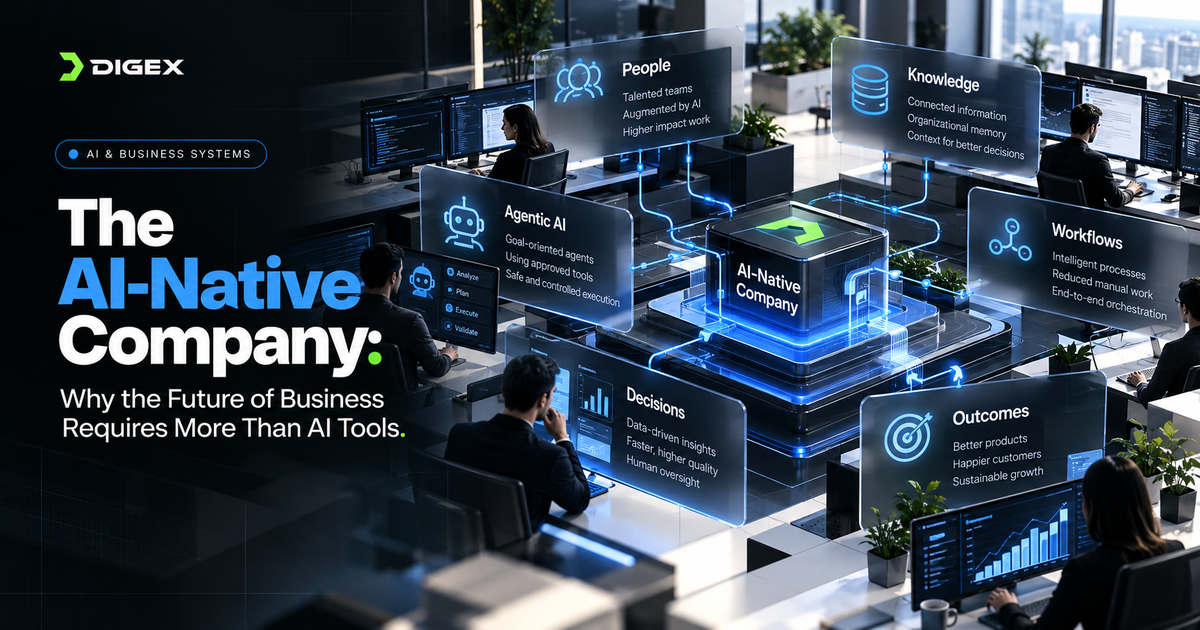
An AI-native company does not simply use artificial intelligence as another productivity tool. It integrates intelligent capabilities into its operating model, connecting people, information, processes, and decisions.
The objective is to create an organization that can understand its operations, respond to changing conditions, and improve continuously.
The fundamental differences
| AI-Enabled Company | AI-Native Company |
|---|---|
| AI is added to existing processes | Processes are designed around intelligent capabilities |
| AI assists individual employees | AI supports connected teams and workflows |
| Knowledge remains distributed across systems | Relevant knowledge becomes accessible through connected systems |
| Decisions rely heavily on manual coordination | Intelligence supports coordination and decision-making |
| Automation focuses on repetitive tasks | Automation can support entire workflows |
| Improvement is often periodic | Feedback supports continuous improvement |
| Productivity focuses on individual tasks | Performance focuses on business outcomes |
Becoming AI-native is not about eliminating human involvement.
It is about allowing people to spend more time on work requiring expertise, creativity, judgment, and responsibility while intelligent systems help manage repetitive and information-intensive activities.
2. Rethinking How Modern Companies Operate
Traditional organizations were designed around the limitations of human communication and information processing.
As businesses grow, they introduce departments, management layers, reporting structures, and coordination processes.
These structures help distribute responsibilities, but they can also create operational complexity.
Consider a typical software development project.
A customer communicates a requirement to an account manager. The requirement moves to a project manager, who prepares tasks for a development team. Developers request clarification. Designers update specifications. Quality assurance teams review implementation. Several rounds of communication follow before the feature is delivered.
Each step may be reasonable individually.
However, the entire process can become slow and fragmented.
Important information may be repeated, misunderstood, delayed, or lost.
An AI-native operating model creates an opportunity to reduce some of this friction.
Instead of relying entirely on people to transfer information between organizational layers, connected intelligent systems can help maintain a shared understanding of projects, priorities, requirements, and outcomes.
Imagine an organization where authorized team members can quickly understand:
- What customers need and why it matters.
- Which projects require immediate attention.
- What technical decisions have already been made.
- Which dependencies are blocking progress.
- What risks could affect delivery.
- How current work contributes to business objectives.
Intelligent systems can help organize, interpret, and surface this information when it is needed.
This doesn't eliminate the need for managers or organizational leadership.
It changes how they can contribute.
Instead of spending significant time collecting updates and coordinating routine information, leaders can focus more deeply on strategy, technical direction, customer relationships, and developing their teams.
The goal is not an organization without structure. It is an organization where structure supports execution rather than slowing it down.
3. From Static Workflows to Continuous Intelligence
One of the most important characteristics of an AI-native company is its ability to learn from the results of its operations.
In a traditional business process, teams plan, execute, complete a task, and move to the next assignment.
Some lessons are documented. Others remain in individual experience or scattered communications.
Over time, valuable organizational knowledge can become fragmented.
An AI-native approach introduces the concept of continuous feedback.
Instead of treating every project as an isolated sequence of tasks, the organization creates a connected cycle:
Understand → Plan → Execute → Validate → Learn → Improve
Each stage produces information that can improve future work.
For example, a software engineering team might continuously analyze:
- Differences between estimated and actual development effort.
- Recurring software defects.
- Common customer change requests.
- Performance issues discovered after deployment.
- Architectural decisions that improved maintainability.
- Patterns that repeatedly delay delivery.
Intelligent systems can assist in identifying these relationships and suggesting improvements.
The result is a company that does more than complete tasks.
It gradually improves how those tasks are performed.
Turning organizational knowledge into a strategic asset
An AI-native company's knowledge base should extend beyond traditional documentation.
Requirements, architecture decisions, project outcomes, test results, and customer feedback can all contribute to a connected understanding of the business.
With appropriate permissions and safeguards, intelligent systems can use this context to support more relevant recommendations.
For example, before starting a new project, a development team might identify similar implementations, reusable components, previously encountered integration challenges, and important architectural considerations.
This reduces unnecessary repetition.
It also allows the company to retain valuable knowledge even as teams and projects change.
The competitive advantage comes not merely from having access to information, but from being able to transform reliable information into useful action.
4. AI-Native Software Engineering: A New Development Model
Software engineering is among the fields experiencing the most visible changes from artificial intelligence.
AI-assisted development can already support code generation, refactoring, documentation, testing, debugging, and technical analysis.
But writing code faster does not automatically mean delivering better software.
A successful engineering process involves much more than implementation.
It requires understanding business requirements, selecting appropriate architecture, protecting sensitive information, maintaining performance, ensuring correctness, and planning for future development.
AI-native software engineering aims to improve the complete development lifecycle rather than accelerating only individual coding tasks.
From code production to solution engineering
In a traditional workflow, developers spend substantial time implementing repetitive logic, writing boilerplate code, preparing tests, and investigating familiar technical problems.
AI agents can assist with many of these activities.
This creates an opportunity for experienced engineers to concentrate more heavily on architecture, system design, complex integrations, performance, security, and product quality.
Consider a new SaaS feature.
The engineering process might begin with a structured specification defining business objectives, expected behavior, validation rules, and acceptance criteria.
AI-assisted tools can help prepare implementation options, generate test cases, analyze existing interfaces, and identify potential technical issues.
Engineers review the outputs, make architectural decisions, and validate the implementation.
The process becomes more collaborative between human professionals and intelligent systems.
Human expertise provides direction. AI accelerates execution. Engineering discipline protects the result.
Specification-driven development
As AI-generated code becomes increasingly common, clearly defined requirements become even more valuable.
A detailed specification can establish what the system must accomplish, what constraints it must respect, and how successful behavior will be verified.
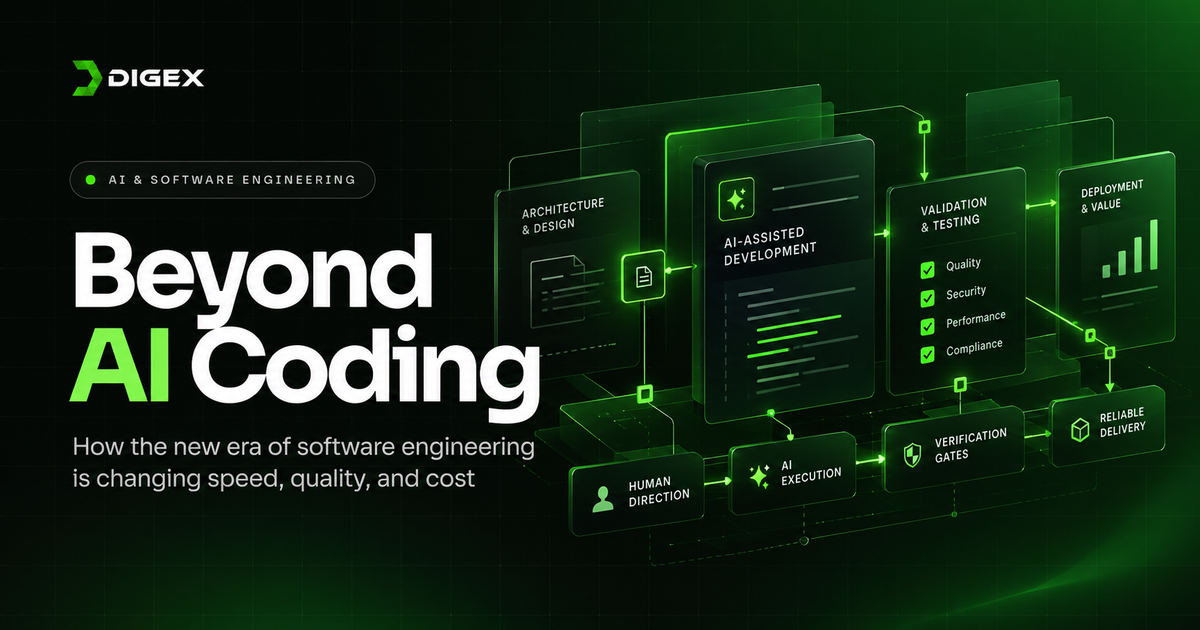
This creates a structured workflow:
Requirements → Architecture → Implementation → Automated Testing → Human Review → Deployment
AI agents can participate in multiple stages, but the output must remain verifiable.
A system that generates code quickly without understanding the required behavior can create more problems than it solves.
The real value emerges when development speed is combined with precise specifications, dependable tests, and strong engineering oversight.
This is particularly important for enterprise applications, financial systems, business automation platforms, and other software where reliability is essential.
5. The Evolution of Teams: More Capability, Less Friction
Traditionally, increasing software delivery capacity has often required expanding the number of people involved in a project.
More developers, designers, project managers, and supporting specialists can increase capacity, but larger teams also introduce additional communication and coordination requirements.
AI-native workflows create an opportunity to rethink that relationship.
A smaller team of experienced specialists, supported by intelligent tools and well-designed processes, may be able to handle work that previously required more extensive coordination.
For example, an experienced engineer working with AI-assisted development tools may be able to prepare prototypes, implementation plans, initial test suites, and technical documentation much more efficiently.
A designer may be able to validate interface concepts using working prototypes rather than static mockups alone.
A project manager may use intelligent systems to identify dependencies, summarize progress, and surface risks.
This doesn't mean every role becomes interchangeable.
Professional expertise remains essential.
Engineers understand architecture and technical tradeoffs. Designers understand usability and user behavior. Project managers understand delivery coordination and organizational priorities.
AI helps reduce unnecessary boundaries between these disciplines.
Moving toward outcome-oriented teams
An important shift is from organizing work exclusively around individual tasks toward organizing teams around business outcomes.
Instead of measuring productivity only by completed tickets, written code, or hours spent, organizations can place greater emphasis on the value delivered.
Did the feature solve the customer's problem?
Did the automation reduce operational effort?
Did the new system improve reliability?
Did the project create measurable business value?
These questions encourage collaboration and shared responsibility.
An AI-native organization should make it easier for people to contribute to outcomes without losing clear ownership and accountability.
6. Agentic AI: From Assistance to Controlled Execution
AI-native organizations can go beyond traditional AI assistance by introducing agentic workflows.
An AI agent is a system designed to pursue a defined objective by interpreting context, selecting permitted actions, using tools, and evaluating results.
Instead of responding only to isolated requests, an agent can participate in a sequence of activities.
In software development, an agent might help analyze a reported issue, investigate the relevant code, prepare a proposed fix, execute available tests, and summarize the result for review.
In business operations, agents could assist with document processing, data reconciliation, internal reporting, customer request classification, or workflow coordination.
This creates an important transition:
From AI that provides answers to AI that helps accomplish work.
However, autonomy must be carefully designed.
Not every decision should be automated.
An AI agent preparing documentation presents a different level of risk from one modifying production infrastructure, accessing sensitive customer data, or executing financial transactions.
A responsible implementation distinguishes between tasks that can be safely automated and actions requiring explicit authorization.
Agentic systems should operate through clearly defined tools, permissions, validation rules, and audit mechanisms.
Human professionals remain accountable for consequential decisions.
The objective is not maximum autonomy.
It is useful autonomy within reliable boundaries.
7. Speed, Quality, and Security Must Evolve Together
One of the biggest risks of AI-assisted development is confusing the speed of code generation with the quality of the software being produced.
AI can generate implementations rapidly, but generated code can still contain security vulnerabilities, inefficient database queries, incorrect business logic, or architectural weaknesses.
Without appropriate controls, faster development can also mean faster accumulation of technical debt.
For this reason, an AI-native engineering company must invest in verification and governance as carefully as it invests in automation.
Important practices include:
Architecture and design review. Systems must follow coherent architectural principles rather than becoming collections of disconnected generated components.
Automated testing. Unit, integration, and end-to-end tests help detect regressions and verify expected behavior.
Security validation. Authentication, authorization, data protection, dependency security, and input validation must remain integral to development.
Code quality and maintainability. Implementations should be understandable, consistent, and supportable over time.
Controlled deployment. Production changes should pass through appropriate review, validation, and release processes.
Monitoring and continuous improvement. Real operational outcomes should inform future improvements.
AI can assist with many of these safeguards, but responsibility for their effectiveness remains with the engineering organization.
Engineering discipline becomes more valuable, not less
As implementation becomes easier, the ability to define correct behavior and recognize incorrect solutions becomes increasingly important.
Strong technical leadership, architectural judgment, security expertise, and quality assurance become critical differentiators.
The best engineering organizations will not simply produce more software.
They will build software that delivers value reliably and remains maintainable as business requirements evolve.
At DIGEX, we believe the most effective use of AI is to accelerate delivery while preserving high engineering standards.
Speed matters.
But so do reliability, security, and long-term quality.
8. What the AI-Native Transformation Means for Businesses
The transition toward AI-native operations is not limited to technology companies.
Businesses across industries face similar challenges: fragmented information, repetitive processes, delayed decisions, and increasing operational complexity.
AI-native thinking encourages organizations to examine these challenges more systematically.
For an e-commerce company, the opportunity might involve connecting inventory, purchasing, customer support, and fulfillment into more intelligent workflows.
For a service business, it could involve coordinating customer requests, scheduling, operational knowledge, and reporting.
For a SaaS company, it might involve improving product intelligence, customer onboarding, support workflows, and internal operations.
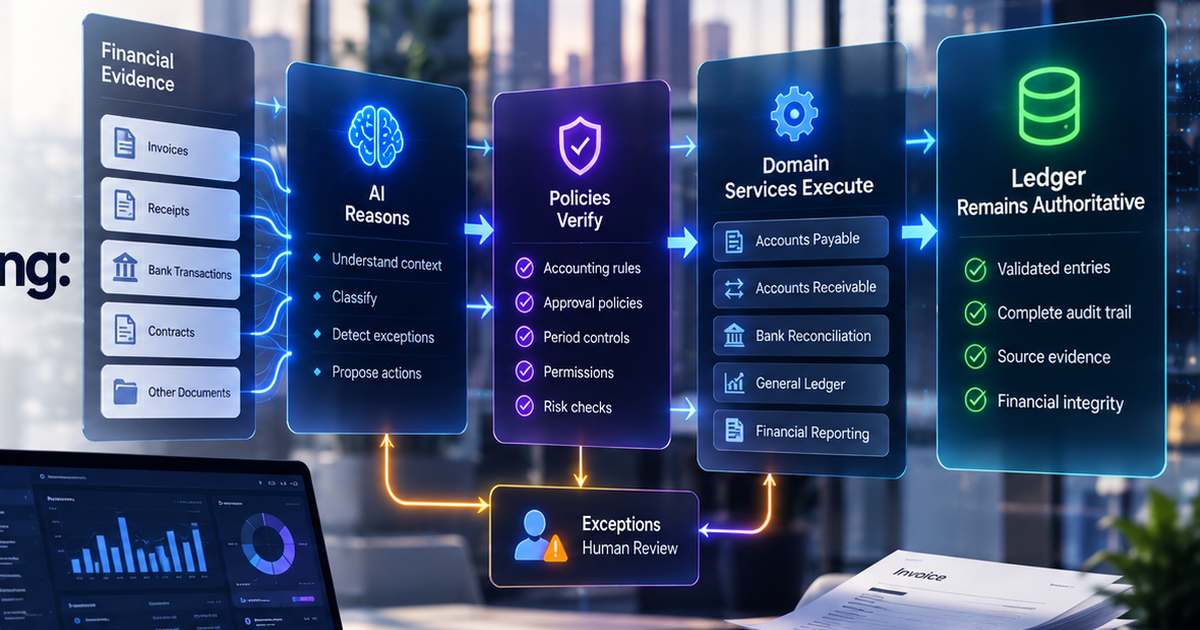
For a financial platform, intelligent capabilities could help process documents, reconcile information, identify exceptions, and support decisions while preserving accounting controls.
The appropriate solution will vary.
Not every business requires autonomous agents.
Not every problem needs a large language model.
And not every existing application should be rebuilt from scratch.
The most effective approach begins with understanding the business.
Where does valuable information become disconnected?
Which processes consume unnecessary manual effort?
Where do delays affect customers?
Which decisions require human expertise, and which can be supported through intelligent automation?
Only after answering these questions should a company determine the right technology and architecture.
Technology should serve the business objective—not become the objective itself.
9. The DIGEX Perspective: Engineering for an AI-Native Future
At DIGEX, we see artificial intelligence as a fundamental evolution in software engineering and digital business.
Our foundation is in building software applications, SaaS products, custom platforms, integrations, and business automation solutions.
The AI-native transformation creates an opportunity to build on that experience and rethink how digital solutions are designed and delivered.
Our direction is guided by three principles.
Intelligence by design
We believe intelligent capabilities should be considered from the beginning of a project when they can create meaningful value.
That does not mean integrating AI into every feature.
It means understanding where context-aware systems, automation, and agentic workflows can improve the way a business operates.
A well-designed solution may combine conventional application logic, deterministic workflows, APIs, databases, AI models, and controlled agents.
Each technology should serve a clear purpose.
Engineering excellence without compromise
AI can accelerate many stages of development, but reliable software still depends on disciplined engineering.
We believe strong architecture, secure implementation, automated verification, and thoughtful technical decisions should remain central to every project.
The goal is not simply to deliver faster.
It is to improve the efficiency of development while preserving the qualities that make software dependable over time.
Business outcomes over technical activity
Our view of a modern engineering partnership extends beyond providing developers to complete predefined tasks.
We want to help businesses understand their operational challenges, identify practical opportunities for improvement, and select technologies that support meaningful results.
Sometimes this means building a new platform.
Sometimes it means improving an existing application.
Sometimes it means automating a repetitive workflow or introducing AI capabilities into an established business process.
What matters is creating measurable value.
From traditional outsourcing to intelligent engineering partnerships
The traditional software outsourcing model often begins with a question:
"How many developers do we need to build this project?"
AI-native engineering creates an opportunity to ask a more useful question:
"What combination of human expertise, intelligent systems, and engineering processes will deliver the best outcome?"
This shift moves the conversation from development capacity alone toward efficiency, technical quality, innovation, and business value.
For DIGEX, it represents the direction of modern software engineering partnerships.
Not replacing human expertise.
Not automating everything.
But combining experienced professionals with intelligent technologies to build better systems and solve more complex problems.
10. Becoming AI-Native Is a Journey, Not a Switch
There is no single technology purchase or organizational change that instantly makes a company AI-native.
The transition requires experimentation, investment in knowledge, redesign of workflows, and a willingness to question established practices.
A practical transformation begins with a few deliberate steps.
First, make existing workflows more observable. Understand how information moves, where delays occur, and what outcomes matter.
Next, identify repetitive or information-intensive activities where AI assistance can create measurable value.
Then, introduce connected knowledge systems, reliable evaluations, and structured feedback.
As confidence grows, organizations can introduce carefully controlled automation and agentic capabilities.
Throughout the process, human accountability, security, and quality must remain central.
The goal is not to maximize the number of tasks performed by AI.
It is to create a business that operates more intelligently and responds more effectively to its customers.
The strongest AI-native organizations will continue to adapt as technology evolves.
Their advantage will come not from dependence on one particular model or tool, but from developing the ability to learn, evaluate, and improve continuously.
11. The Future Belongs to Companies That Combine Intelligence with Expertise
The rise of AI-native companies marks an important transition in the evolution of business and technology.
For years, digital transformation focused on converting manual processes into software-driven workflows.
The next stage introduces systems capable of interpreting context, supporting decisions, coordinating actions, and learning from outcomes.
This shift has the potential to change how organizations are structured, how software is engineered, and how value is delivered to customers.
But technology alone will not determine success.
The organizations that benefit most will be those that combine intelligent systems with strong expertise, reliable processes, clear accountability, and a deep understanding of customer needs.
They will measure progress not by how many AI tools they adopt, but by how effectively they solve problems.
They will use automation to remove unnecessary complexity while keeping people responsible for important decisions.
And they will recognize that speed is valuable only when it is accompanied by quality.
DIGEX — Engineering What's Next
At DIGEX, we believe the next generation of technology companies will be defined by their ability to combine human expertise, intelligent automation, and disciplined engineering.
The future is not simply AI-powered software.
It is an entirely more intelligent approach to building products, organizing work, and delivering business value.
We are embracing that direction as we continue evolving how we engineer software and approach complex business challenges.
Because the future of technology is not about choosing between humans and artificial intelligence.
It is about bringing their strengths together to build what comes next.